Contact Us
01482 228202
Working Hours
24 / 7 / 365
E-mail Us
info@arrow-industrial.co.uk
If you are responsible for work equipment on your site, PUWER is not a recommendation you can get to next quarter. It is a legal duty and industrial doors, loading bays, gates and barriers all fall under it.
Arrow helps organisations understand those obligations and turn complex regulations into practical compliance actions. Whether you operate a warehouse, manufacturing facility, logistics hub, retail distribution centre or public sector site, we identify the risks, improve equipment safety and keep you compliant.
Our PUWER compliance programme covers:
The Provision and Use of Work Equipment Regulations 1998 place a legal duty on employers to ensure work equipment is:
The equipment must be right for the task, the environment and the people using it. A door specified for light office use does not belong on a high-cycle despatch bay.
Maintenance is not optional and not something you get to when the budget allows. Safety devices — photocells, safety edges, force limiters — must work, not merely exist.
Inspection frequency must be appropriate to the risk, the usage and the manufacturer’s guidance. “Competent” means demonstrably trained and experienced, not simply available.
Operators need to know how the equipment works, what its limits are, and what to do when something goes wrong.
PUWER applies far more widely than most sites assume. Industrial doors, loading bay systems, dock levellers, gates, barriers and their associated safety devices are all work equipment. If it moves, and your people work around it, it is in scope.
Arrow supports PUWER compliance across the full range of powered and manual door assets, along with the safety systems around them.
Roller shutters, high-speed doors, sectional doors, spiral doors, and sliding and folding doors. These are the highest-risk assets on most sites — heavy, powered, and operating in the same space as people and vehicles.
Dock levellers, dock shelters, dock seals and vehicle restraints. Loading bays combine height, moving plant and pedestrian traffic, which is why they attract disproportionate HSE attention.
Powered gates and barriers carry well-documented crushing and entrapment risks. Automatic pedestrian doors need their sensors and force settings checked, not just their motors.
Fire doors sit under both PUWER and the Regulatory Reform (Fire Safety) Order 2005. A fire door that will not close is a compliance failure in plain sight.
Photocells, safety edges, light curtains, force limiters, emergency stops and interlocks. These are the components that fail quietly — the door still opens and closes, so nobody notices until someone is hurt.


Arrow is not owned by a door manufacturer and not tied to a single product range. When we recommend a course of action it is the one your site needs, not the one we are contracted to sell.
We assess, maintain and repair equipment regardless of who originally supplied it. Most of the estates we look after were not installed by us. If your site has six manufacturers across nine locations, that is still one contract and one point of contact.
Engineers across the UK, with one point of contact for every site wherever they are, and emergency response 365 days a year.
Not just engineers — inspectors who understand what the regulations require and what the evidence has to look like to be worth anything after an incident.
We inspect, maintain, repair and modernise. One supplier from survey through to replacement, working against a single asset register that follows the equipment rather than the contractor.
Recommendations that prioritise safety and operational continuity. We schedule around your operation, because a compliance programme that stops production does not survive contact with the site manager.

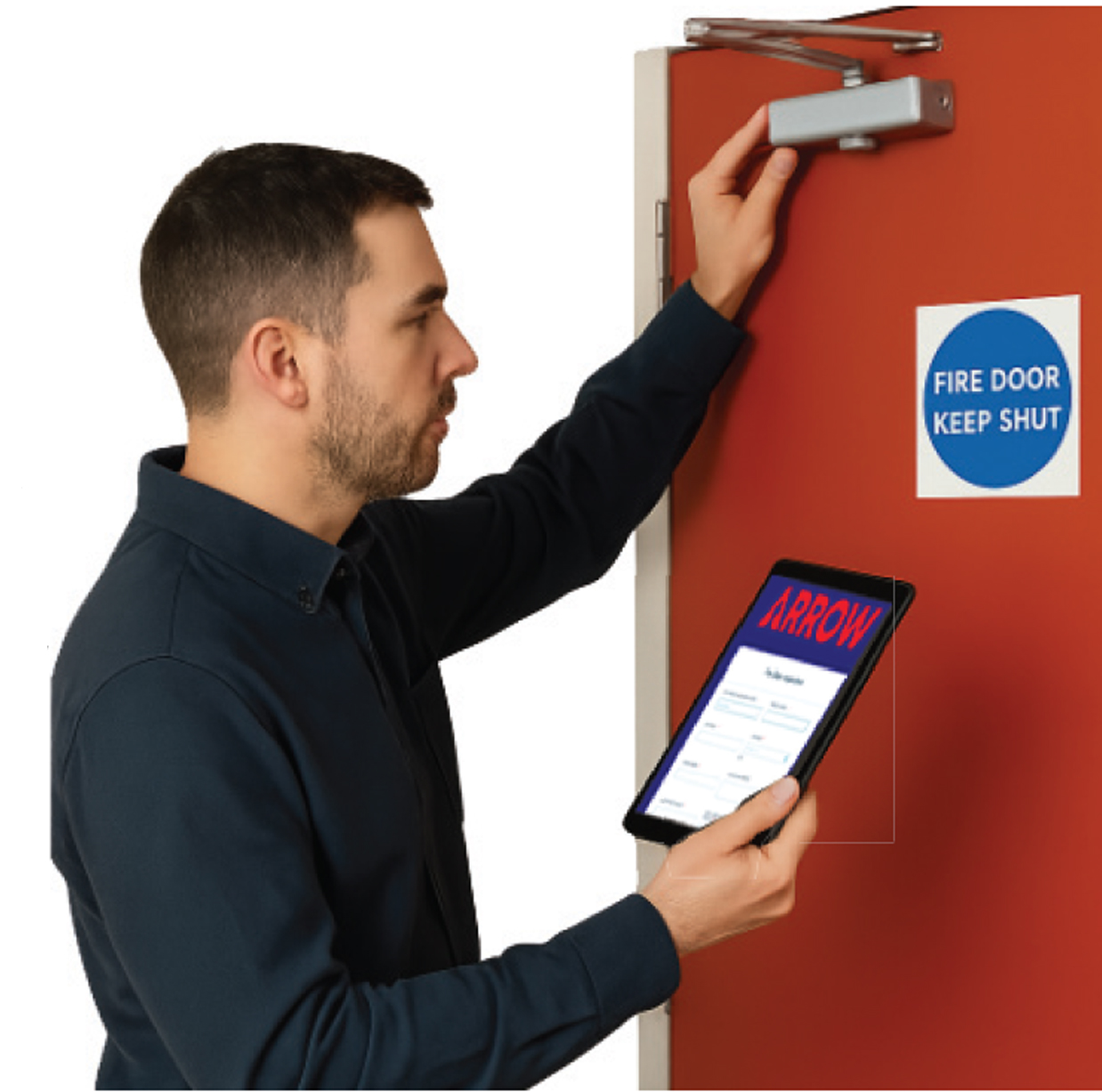
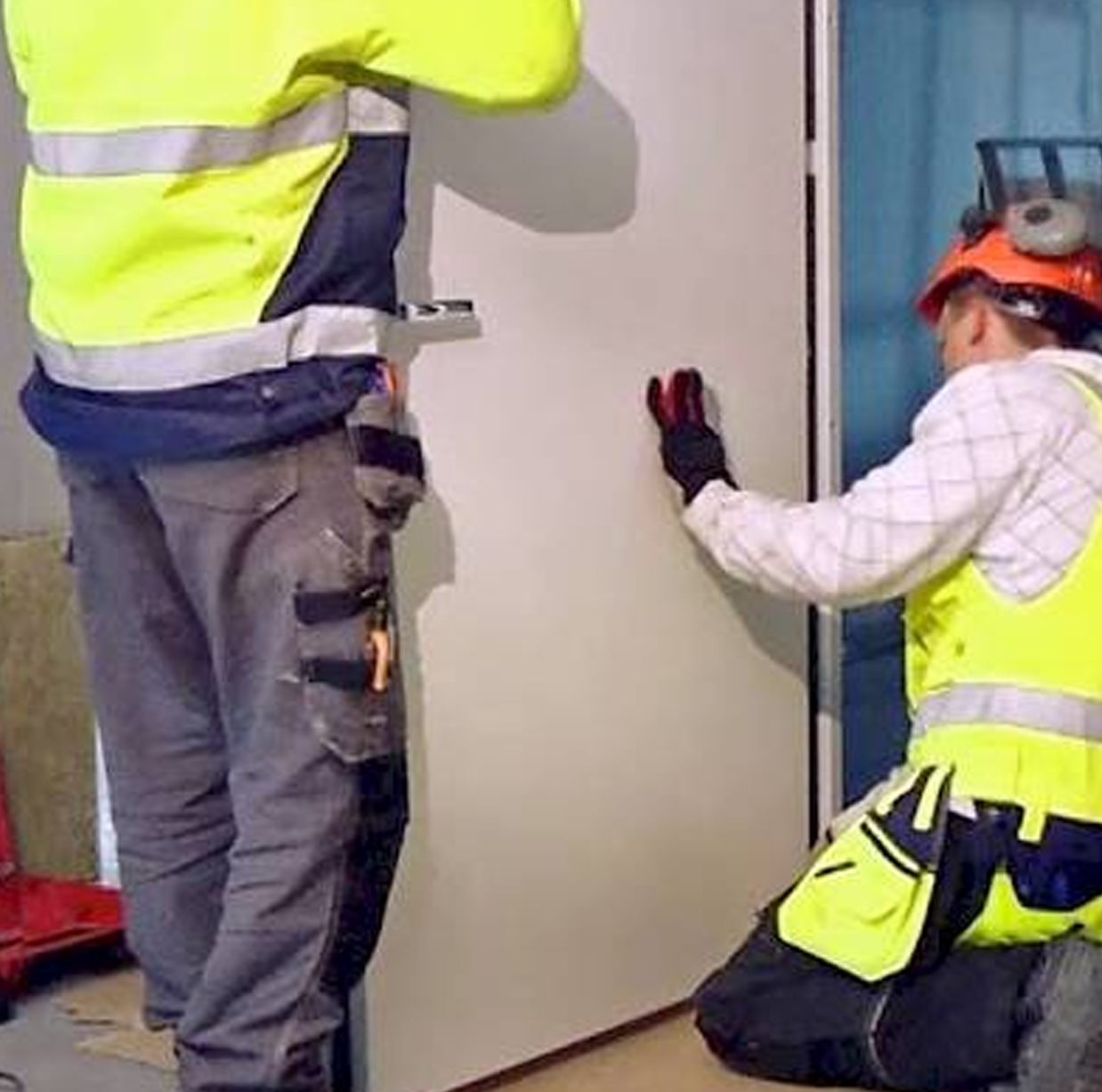

This is the part most sites miss. Every planned maintenance visit generates exactly the inspection record that PUWER requires. Organisations on a maintenance programme are not scrambling for evidence when an auditor asks — the evidence accumulates as a by-product of the work.
Doing nothing is not neutral. It is a compliance gap that grows every month.
Failure to comply with PUWER can lead to:
The uncomfortable version: after an incident, the question is not whether you meant to comply. It is whether you can produce the records that show you did.
Most organisations know the regulations exist. Far fewer can produce the evidence that they have met them — and evidence is the only thing that counts when an inspector, an insurer or a solicitor asks.
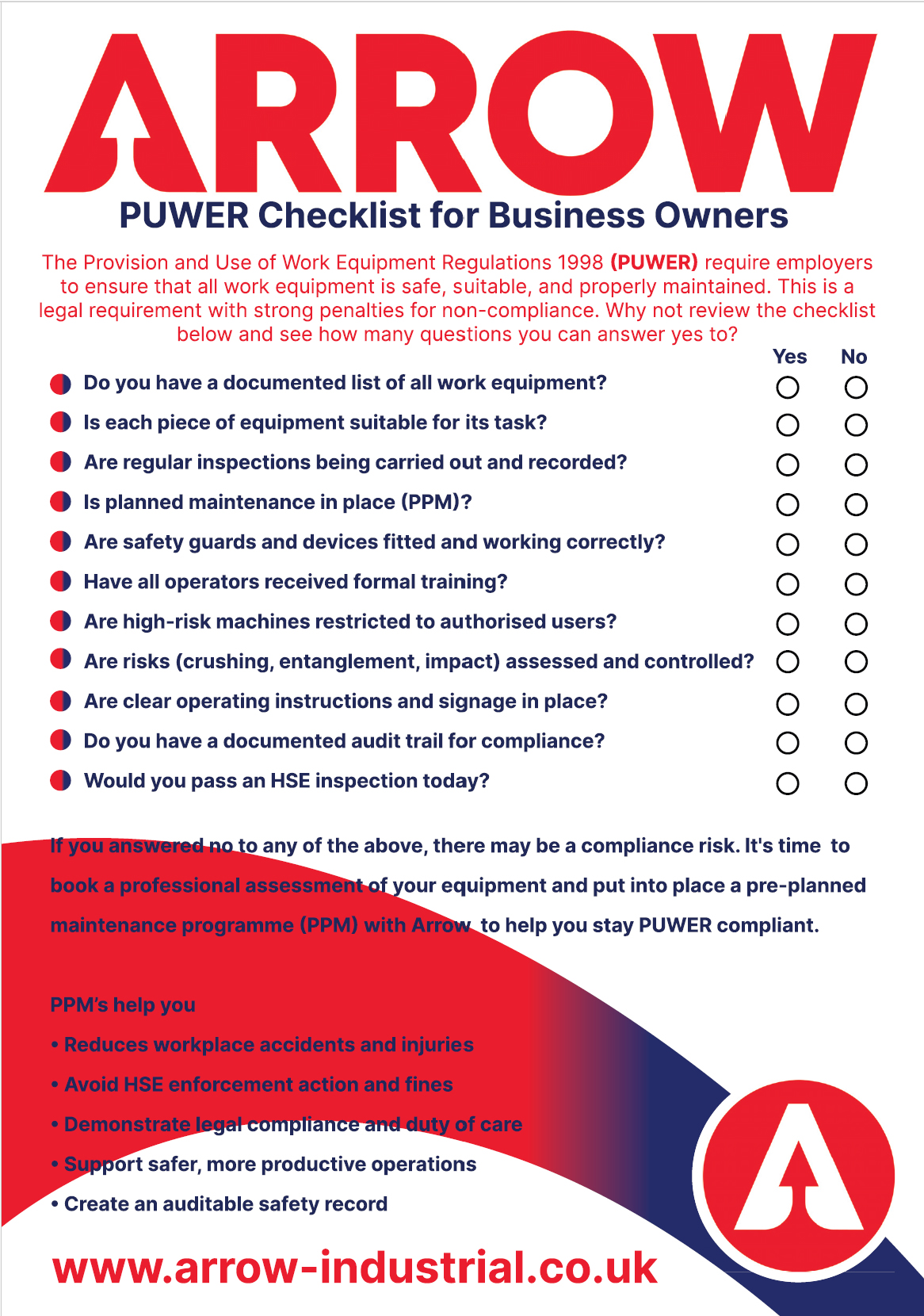
The Provision and Use of Work Equipment Regulations 1998 require employers to ensure that all work equipment is safe, suitable and properly maintained. This is a legal requirement with strong penalties for non-compliance. Answer honestly — how many of these can you say yes to?
If you answered no to any of the above, there may be a compliance risk. The next step is a professional assessment of your equipment and a planned maintenance programme to keep you compliant.
Warehousing, manufacturing, logistics hubs, retail distribution centres, food production, waste and recycling, and public sector estates.
In practice: any site where vehicles and people move through the same openings, and where a door failure stops work.
If you are responsible for equipment across several sites, the hardest part is rarely the inspection. It is knowing what you have, where it is, and when it was last looked at. Arrow builds and maintains a single asset register across your whole estate — one point of contact, one reporting format, one schedule, regardless of who originally supplied the equipment.

There is no single legal interval that covers every asset. The obligation under PUWER is that inspection frequency is appropriate to the risk, the usage and the manufacturer’s guidance. In practice:
These are working guidelines based on typical usage. Arrow will recommend a schedule for your specific assets as part of the survey.
An inspection that finds a fault on every door is not an inspection, it is a quotation.
Arrow reports what we find, ranks it by risk, and tells you plainly what needs doing now, what can wait, and what does not need doing at all. You get photographic evidence of every defect and a clear pass, fail or remedial-action status against each asset.
You are then free to have the remedial work carried out by anyone. Most customers ask us — but that is a decision you make after the report, not before.
Every relevant asset identified, located and logged — including the ones that are not on any existing register. Most sites have more work equipment than their records show.
Mechanical condition, safety devices, control systems and evidence of previous work. We test the safety functions rather than assuming they work because the door does.
What meets the requirement, what does not, and what is borderline. We do not pad the report — an inspection that finds a fault on every door is not an inspection, it is a quotation.
Risks ranked by severity, actions recommended, photographic evidence of defects. Nothing left implied.
Costed, prioritised and scheduled around your operation. You are free to have the work done by anyone — most customers ask us, but that is a decision you make after the report, not before.
A single record of what you own, where it is and what condition it is in — something you can hand to an auditor, an insurer or the HSE.
Yes. PUWER defines work equipment very broadly — any machinery, appliance, apparatus or installation for use at work. Powered doors, shutters, loading bay equipment, gates and barriers all fall within it, as do their safety devices.
The duty sits with the employer and the person in control of the premises. You can contract out the inspection and the maintenance; you cannot contract out the responsibility. That is precisely why the documentation matters.
Not necessarily. A maintenance visit and a PUWER inspection are not the same thing, and many contracts cover the former without evidencing the latter. The test is whether you hold a dated, written record showing what was inspected, by whom, what was found and what was done about it.
PUWER does not set a fixed interval. It requires a frequency appropriate to the risk, the usage and the manufacturer’s guidance. For most powered doors that means every six months, and quarterly for high-cycle assets.
Someone with the training, experience and knowledge to identify defects and assess their significance. In practice that means demonstrable qualifications and familiarity with the equipment type — not simply whoever is available on the day.
An asset register listing every item of work equipment, dated inspection records for each, evidence of remedial work carried out, and records of operator training. Arrow provides the first three as standard.
A survey takes about an hour on a typical site and costs nothing. We walk your doors, loading bays and barriers, tell you what is compliant and what is not, and put it in writing before you commit to anything.

The Provision and Use of Work Equipment Regulations 1998 place a legal duty on employers to ensure work equipment is suitable, safe, maintained and inspected by competent people. Penalties for non-compliance are significant, and the duty cannot be delegated to a contractor. Arrow provides the inspection, documentation and remedial work that evidences compliance — the responsibility remains yours, but the paperwork does not have to.